 blog
Seven Questions to Ask Before Hiring an Extension Builder
Last Updated: October 25, 2026
Quick Summary
The seven questions to ask before hiring an extension builder cover experience and project history, quote details and inclusions, references from similar work, payment schedules and variation approval, realistic timelines with risk factors, named site supervision and contact, and warranty and dispute handling. These questions reveal whether a builder is professional, experienced, and trustworthy before you commit to a contract.
- Ask for specific examples of completed projects in similar properties and contact details for recent clients to verify experience.
- Demand a detailed quote listing work, materials, labour, timings, and exclusions rather than a single-line price.
- Get a phase-by-phase programme that separates pre-construction months from on-site construction, as planning and building control add significant time.
- Require a written contract before work starts that includes scope, materials, price, payment schedule, start and completion dates, and a variations clause.
- Verify public liability insurance, employer's liability insurance, professional indemnity insurance, and building control certification with certificates, not verbal assurance.
Table of Contents
- Do They Have Relevant Experience and Proven Project History?
- What Questions to Ask a Builder Before Hiring
- What Should a Builder's Quote Include?
- Are They Licensed, Insured, and Qualified?
- Home Extension Contract Checklist: What Terms Must Be in Writing
- What Is the Home Extension Timeline and Project Schedule?
- How Will They Handle Planning Permission and Building Regulations?
- Getting Your Extension Builder Questions Answered
- Frequently Asked Questions
Do They Have Relevant Experience and Proven Project History?
First, check whether the builder has completed projects like yours. Don't just ask how long they've been in business, ask for specific examples in similar properties.
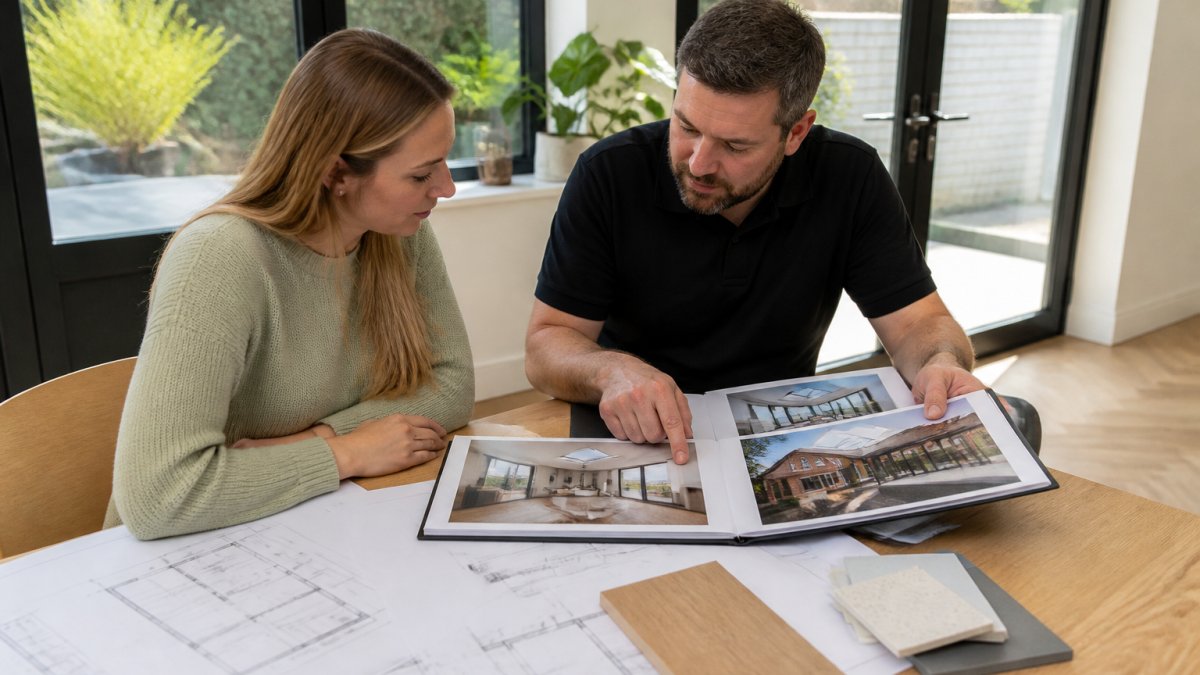
A terraced house in Bath has different constraints than a detached home in Somerset; an experienced builder spots problems early and avoids costly mistakes.
Ask for photos of completed work and contact details for recent clients. Hesitation is a red flag.
When you call past clients, ask: Did the project finish on time? Did costs stay close to the estimate? How were problems handled? These conversations reveal more than any website claim.
Experience matters most when:
- Your property has unusual features (narrow access, listed status, difficult neighbours)
- You need specialist work like loft conversions or garden rooms
- You're working with tight timelines or budgets
See our portfolio of extensions, loft conversions, and garden rooms(page:1)
What Questions to Ask a Builder Before Hiring
Asking the right questions separates builders who deliver from those who don't.
1. How will you handle planning permission and building regulations for this specific extension?
This is non-negotiable.
2. What's included in your quote, and what isn't?
A vague quote leads to arguments about costs.
3. Can you provide references from similar extensions?
Ask for three recent clients whose properties are similar to yours, same construction type, access, and boundary conditions. Call them and ask whether the project finished on the agreed date, whether the final account matched the quote, how variations were priced, and whether they'd hire the builder again.
4. What's your payment schedule, and how are variations approved?
Ask how variations are priced and approved.
5. How long will the project take, and what could delay it?
Get a realistic timeline in writing, broken into phases.
6. Who will supervise the work day-to-day, and who is my main contact?
7. What happens if something goes wrong?
Ask about warranties, defect liability periods, and dispute handling.
See our portfolio of extensions, loft conversions, and garden rooms(page:1)
What Should a Builder's Quote Include?
A proper quote is a detailed breakdown, not a single number. It protects both you and the builder by setting clear expectations.
A complete quote should contain:
- Scope of work (what will be built, materials, finishes)
- Labour costs and how many workers will be on site
- Material costs broken down by item
- Timelines for each phase
- Payment schedule and deposit amount
- Allowances for unknowns (provisional sums)
- What happens if costs change
- Exclusions (what's not included)
- Start and end dates
- Site access and parking arrangements
Get quotes from at least two builders and compare like-for-like. If one is much lower, ask why, it may mean different materials, fewer workers, a longer timeline, or an underestimate.
Watch for vague items like "labour" without a breakdown. The more detailed the quote, the fewer surprises you'll face.
The cheapest quote often becomes the most expensive once changes and delays add up. Choose on value, experience, reliability, and a detailed plan.
Are They Licensed, Insured, and Qualified?
Before you hire, verify credentials. A legitimate builder carries the right insurance and qualifications.
Check for:
- Public liability insurance (covers damage to your property or injury to workers)
- Employer's liability insurance (if they have employees)
- Professional indemnity insurance (covers design errors or poor workmanship)
- Building control certification or membership with a recognised body
- Relevant trade qualifications
Ask to see certificates, don't accept verbal assurances. Insurance lapses happen, and you need to know you're covered.
A builder working in Bristol, Bath, or Somerset should know local building regulations. Ask whether they've worked with your local authority before.
Check online reviews for patterns. One negative review might be unfair; multiple complaints about the same issue suggest a real problem.
Learn about our qualifications and reputation(page:2)
Home Extension Contract Checklist: What Terms Must Be in Writing
Never start work without a written contract. Verbal agreements disappear when problems arise.
Your contract must include:
- Full scope of work (detailed description of what will be built)
- Materials and specifications (brands, quality standards, finishes)
- Total price and payment schedule
- Start and completion dates
- Who pays for what if costs change
- How disputes will be resolved
- Insurance and warranty details
- Site access and working hours
- Contingency for unexpected issues (provisional sums)
- What happens if either party wants to cancel
- Defects liability period (typically 12 months after completion)
A professional builder provides a contract before work starts; resistance is a warning sign. The contract protects you both by making expectations clear.
Have a solicitor review the contract if you're uncomfortable with legal language, the cost is small compared to the protection.
Include a variations clause. Construction often reveals hidden structural damage, outdated wiring, or unforeseen site conditions; the contract should explain how changes are priced and approved before work continues.
What Is the Home Extension Timeline and Project Schedule?
A realistic timeline depends on the size and complexity of your extension, but the biggest source of disappointment is not the build itself, it is the pre-construction period.
Pre-construction (typically 2-5 months, often longer)
- Design and drawing preparation, including structural calculations where needed.
- Planning application and determination, householder applications are commonly determined within around eight weeks, but validation queries, neighbour consultations, and requests for amendments can extend this.
- Building-control application and plan-check, either through the local authority or an approved inspector.
- Party wall notices and awards where the extension is close to a boundary or shares a wall.
- Tendering and contract signature.
- Material ordering, especially for bespoke glazing, kitchens, and structural steel, which can carry lead times of several weeks.
Construction (indicative, project-dependent)
A single-storey rear extension commonly runs 12-16 weeks on site; a two-storey extension or loft conversion often runs 20-28 weeks. Treat these as planning figures, not promises. A phase-by-phase programme usually looks like this:
- Site setup, access protection, and demolition of existing walls or openings.
- Groundworks, foundations, and drainage, with a building-control inspection before concrete is poured.
- Structural frame, steel, and the connection between old and new structures.
- Roof structure and weatherproofing, so the shell is watertight before first fix.
- First fix: plumbing, electrical, and ventilation routes.
- Insulation, plasterboard, and plaster, with building-control inspections at the insulation and pre-plaster stages.
- Second fix: sanitaryware, electrics, heating, and joinery.
- Decoration, snagging, and final building-control inspection leading to a completion certificate.
What actually causes delay
Weather affects outdoor work, particularly groundworks and roofing. Unexpected structural issues, a lintel that is not where the drawings said, or foundations that need deepening, are common in older properties.
Ask what happens if the project runs late. Is there a liquidated-damages clause, or at least a defined completion date with a mechanism for extension? Who bears the cost of delays caused by the builder versus delays caused by building control, the planning authority, or the weather?
Living in the home during construction
This is the question most guides skip, and it is the one that affects daily life most. Ask the builder how they will manage:
- Dust and containment, will there be sealed doors or temporary partitions between the work area and the rest of the house?
- Noise and working hours, what hours will trades be on site, and are there local restrictions?
- Utilities, will water, power, or heating be interrupted, and for how long? Who reinstates them?
- Security, how will the site be secured overnight, and will scaffolding provide access to upper windows?
- Access and parking, where will materials be stored, and will skips or deliveries block the road or a neighbour's drive?
- Unusable space, which rooms will be out of action, and for how long? Will the kitchen be usable throughout?
Learn how we programme extensions and manage occupied homes(page:3)
How Will They Handle Planning Permission and Building Regulations?
Most extensions require both planning permission and building regulation approval. These are separate processes with different purposes.
Planning permission checks whether the extension fits the neighbourhood and doesn't cause problems for neighbours. It covers size, design, and impact.
Building regulations ensure the work is safe and meets current standards. They cover structural safety, energy efficiency, fire safety, and accessibility.
Ask the builder whether they'll manage these applications or whether you need to handle them. Most professional builders manage both.
If the builder says "it probably doesn't need planning permission," get a second opinion.
Building regulation approval happens after completion. You receive a completion certificate proving the work meets standards.
Getting Your Extension Builder Questions Answered
You now have the seven questions to ask before hiring an extension builder. Use them to evaluate every builder you consider. The answers reveal who's professional, experienced, and trustworthy.
Don't rush the selection process. Take time to compare quotes, check references, and verify credentials. The right builder makes the difference between a smooth project and a nightmare.
At F23 CONTRACTORS, we've helped hundreds of families in Bristol, Bath, and Somerset expand their homes with extensions, loft conversions, and garden rooms.
When you're ready to discuss your extension, get in touch. We'll answer your questions and provide a detailed quote with no obligation.
| Question | What It Reveals | Red Flags |
|---|---|---|
| Experience and project history | Whether the builder understands your property type | Vague answers, no references, no photos |
| What's included in the quote | Whether costs are clear or hidden | Single-line quotes, no breakdown |
| Licensing and insurance | Whether you're protected if something goes wrong | No certificates, expired insurance |
| Written contract | Whether expectations are clear and binding | Reluctance to provide a contract |
| Timeline and schedule | Whether the project will finish on time | Unrealistic timelines, no contingency |
| Planning and building regulations | Whether the builder manages compliance | "Probably won't need permission" |
| Payment schedule | Whether money is protected | 50% upfront or payment on completion only |
Frequently Asked Questions
What questions to ask a builder before hiring should I prioritize?
Start with credentials: ask for proof of insurance, building control registration, and references from recent extension projects. Then clarify scope: what is included in the quote, what happens if building regulations issues arise, and who manages planning permission. Finally, confirm the contract terms, payment schedule, and dispute resolution process. These seven questions form a complete due-diligence checklist before you sign anything.
What should a builder's quote include to be fair and complete?
A detailed quote must break down labour costs, materials, fixtures, and any provisional sums for unknowns like structural work. It should specify what is included (scaffolding, waste removal, building control fees) and what is excluded. Ask whether the quote covers planning permission applications and building regulation sign-off. A vague estimate is a red flag; a transparent, itemised quote protects both you and the builder.
What happens if something unexpected happens during my extension build?
Your contract should define how change orders and variations are handled. Ask upfront how the builder will notify you of delays, cost increases, or structural surprises, and what approval process you must follow. Confirm whether unexpected asbestos, poor foundations, or weather delays are covered under contract terms or charged as extras. A clear variation clause prevents disputes and keeps your project on track.
How long does a typical home extension usually take?
Timescale depends on size, complexity, planning permission delays, and building regulation inspections. Ask your builder for a realistic schedule broken down by phase (foundations, frame, weatherproofing, interior), and confirm who supervises the work and who is your main contact. A written project timeline in your contract protects you from open-ended delays.